
0
Your Cart
0
Your Cart

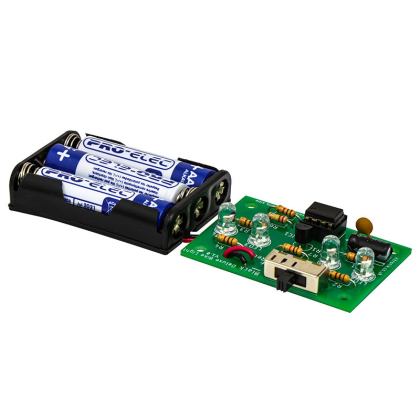
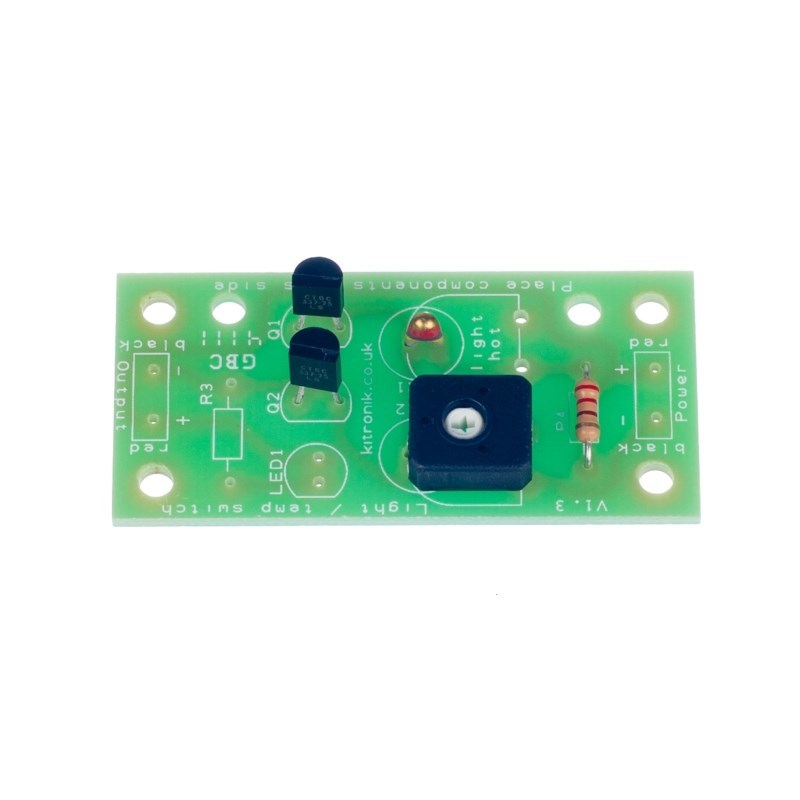
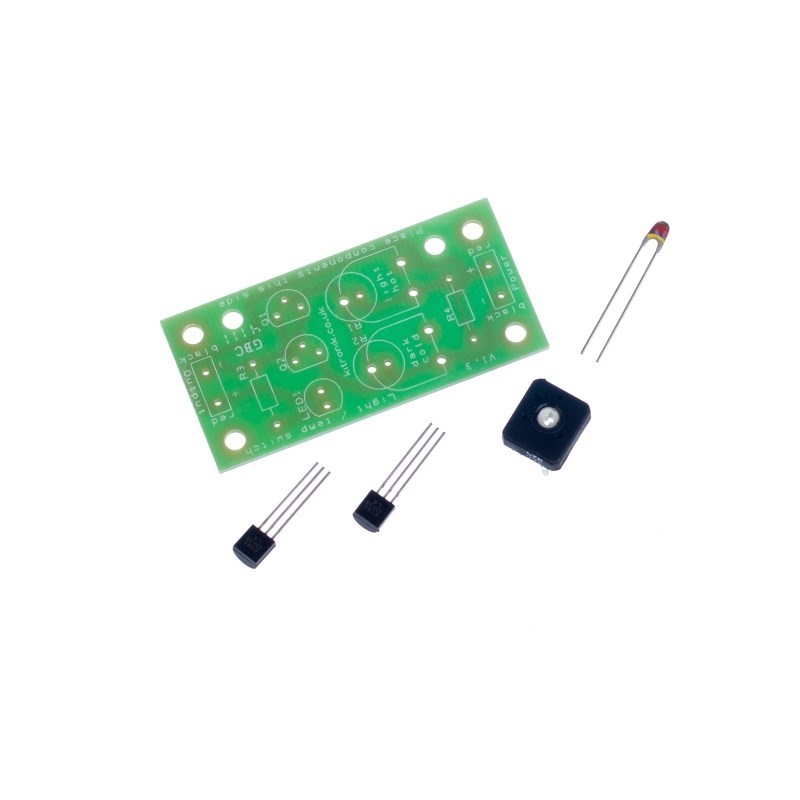
This temperature activated project kit is also available as a light activated project kit. The output of this board can be used to control other electronic circuits, turning them on automatically when it goes hot or cold.

The board has space for an LED with current limit resistor (both available separately) which will light when the output turns on.

The Darlington pair transistor configuration allows an output current of up to half an amp to be controlled. Operating voltage 3V to 10V (lower voltages allow for better adjustment of the switching point).

Features:

  • The Temperature Switch Kit detects the temperature of its surroundings using a thermistor.
  • The kit acts as an automated on/off switch (temperature dependant).

Contents:

Possible applications include:

  • Babies bath over temperature indicator.
  • Automatic fan.

Dimensions:

  • PCB Length: 53mm.
  • PCB Width: 25.5mm.

Requires:

Resources:

Note:

  • This kit requires soldering.

Documents & downloads

Note:

  • This kit requires soldering.

Related resources

Reviews

There are no reviews yet.

Be the first to review “Kitronik Heat Activated Switch”

Your email address will not be published. Required fields are marked *

Questions and answers

    What voltage is required to run this circuit? Can I use the 3V Coin Cell battery board?
  1. 0 votes
    Q What voltage is required to run this circuit? Can I use the 3V Coin Cell battery board?
    Asked by Diane Brancazio on March 1, 2019 12:00 am
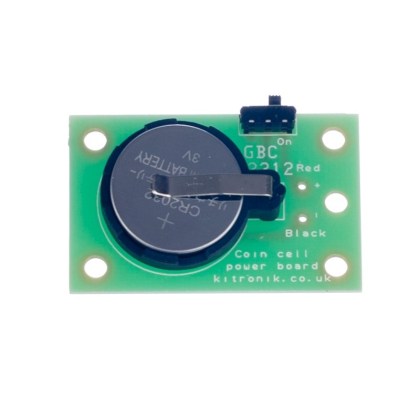
    Answered by the admin Hi Diane, Thank you for your message the kit can run from 3V to 10V. So a Coin cell would work with this but you might be limited by it's low charge running down after a short time (about 6 hours with a standard LED turned on by the kit). Best Regards Cullen
  2. Is a 12volt battery too powerful for the components in the switch?I would like to use this to power a small fan in an equally small greenhouse but the battery will be charged using a small solar panel.I asked this question using the light switch yesterday as example but have not had any reply as yet Thanks
  3. 0 votes
    Q Is a 12volt battery too powerful for the components in the switch?I would like to use this to pow...... Read more
    Asked by Anthony Morris on March 27, 2018 12:00 am
    Answered by the admin Hi Anthony, The components on this kit has a slightly lower voltage than on the light activation kit. As such this kit can only be powered by a maximum of 10V. You could use a step down regulator to take the voltage down below 10V.
  4. Hi, I would like to put leads on the thermistor to use in a solar batch heater I am making, what distance away from the board could the leads be and still work? I am thinking of using the kit to turn on the gas water heater when the solar water is cool, the heater uses a 1.5 D battery to light the gas. I am guessing the heater's system needs the ampage a D cell provides so I want to hack into the Dcell compartment , cut the link and run it to a relay worked by the kit. If that sounds possible could you advise on a suitable relay. regards steve ps I do have another question regarding this kit in either configuration, could it be used to detect a specific voltage on 1 to 3 rechargeable 1.2 volt batteries and switch off . I would like to make a solar lamp that will give out some useful light but do not want to completely empty the battery/ batteries every night.
  5. 0 votes
    Q Hi, I would like to put leads on the thermistor to use in a solar batch heater I am making, what ...... Read more
    Asked by steve on May 13, 2007 12:00 am
    Answered by the admin Hi Steve, The maximum lead length would depend on the resistance of the type of w
    ire being used but it would be somewhere in the hundreds/thousands of feet range. That sounds like it should be workable. I don't know the exact details of the heater and its tolerances for lighting the gas but if you powered the temperature switch kit with 2 D batteries it would output roughly 2V at up to 0.5A which I expect would be plenty for your heater if it is currently running from 1 D battery. (0.9V is lost through the transistor pair on the board.) So you might not need a relay. You could use this relay though http://www.kitronik.co.uk/products/components/relays/5v-relay-single/ but you would need to use 4xAA batteries with the temperature kit to trigger the relay. For your final question I would not recommend using this board to measure a specific voltage, the drop over the darlington pair is about 0.9V which is a massive proportion of the 1.2V your batteries provide. You would be better off using a voltage divider circuit and a single transistor.
To submit a question, please login or create an account