
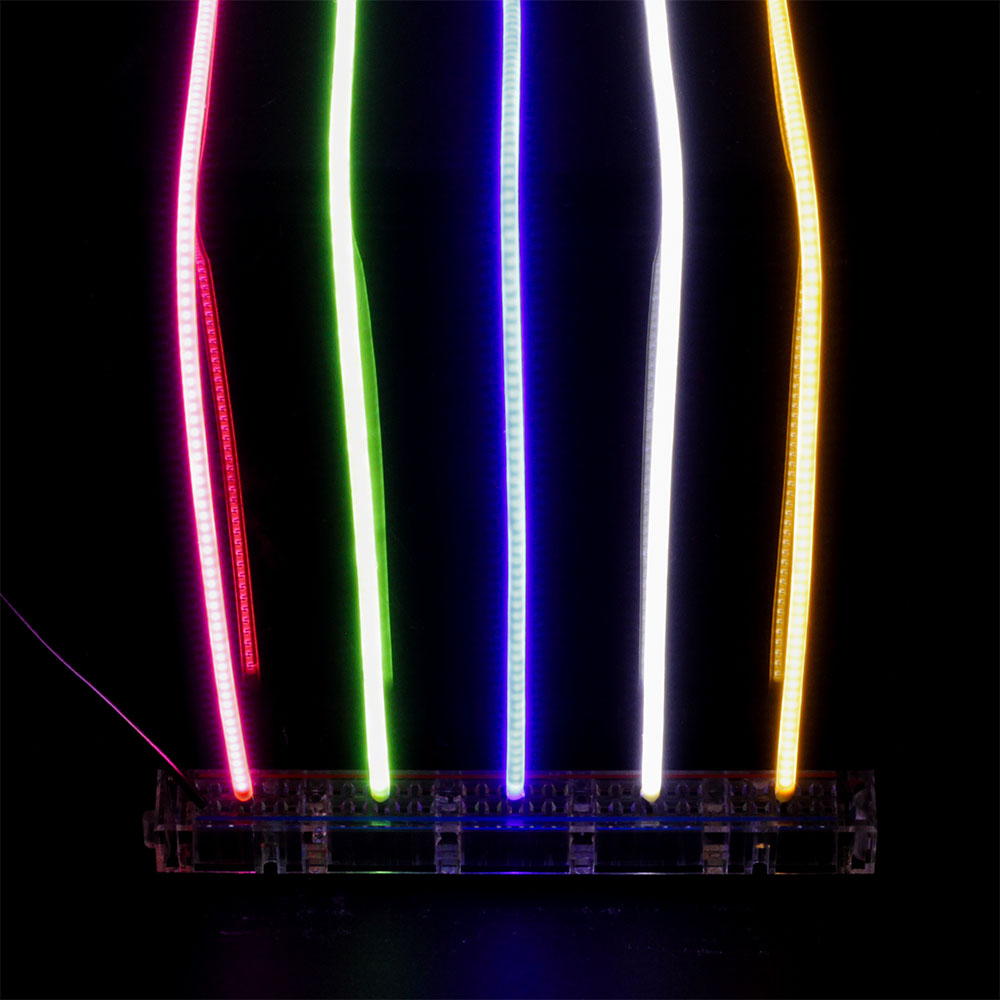

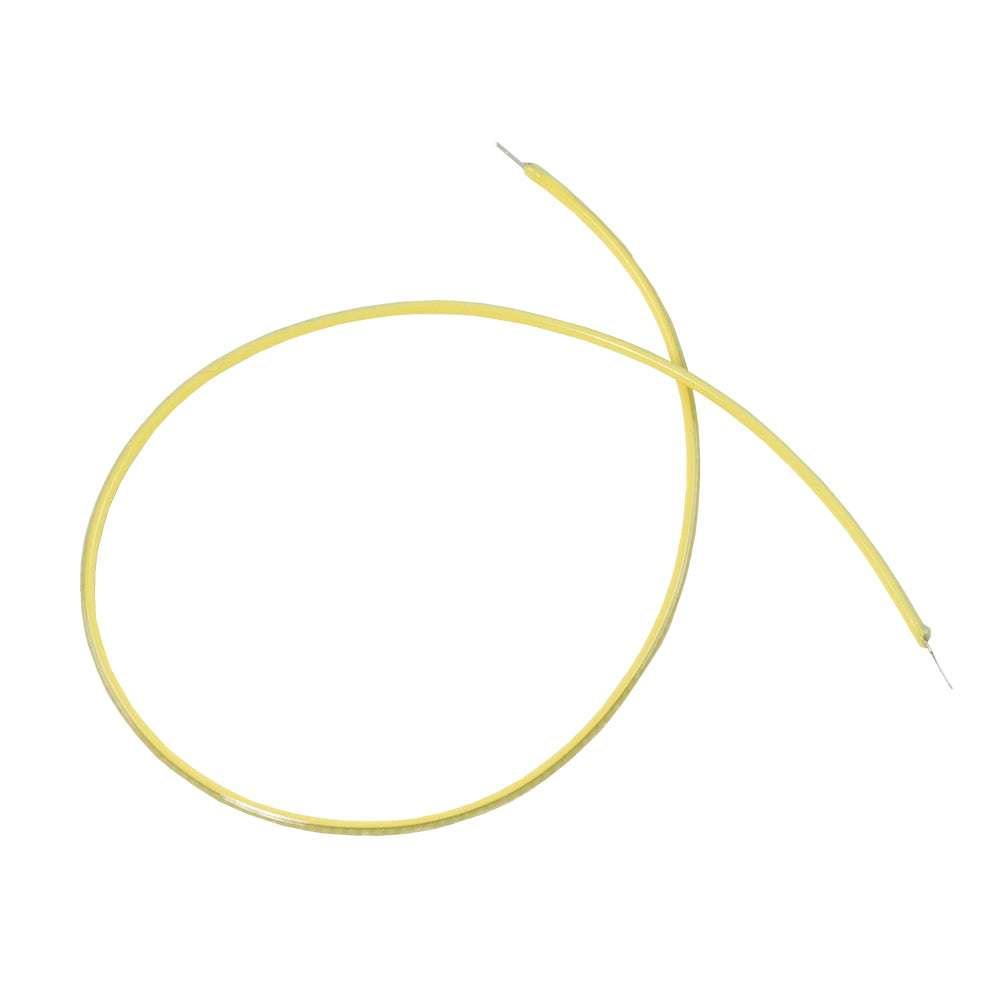
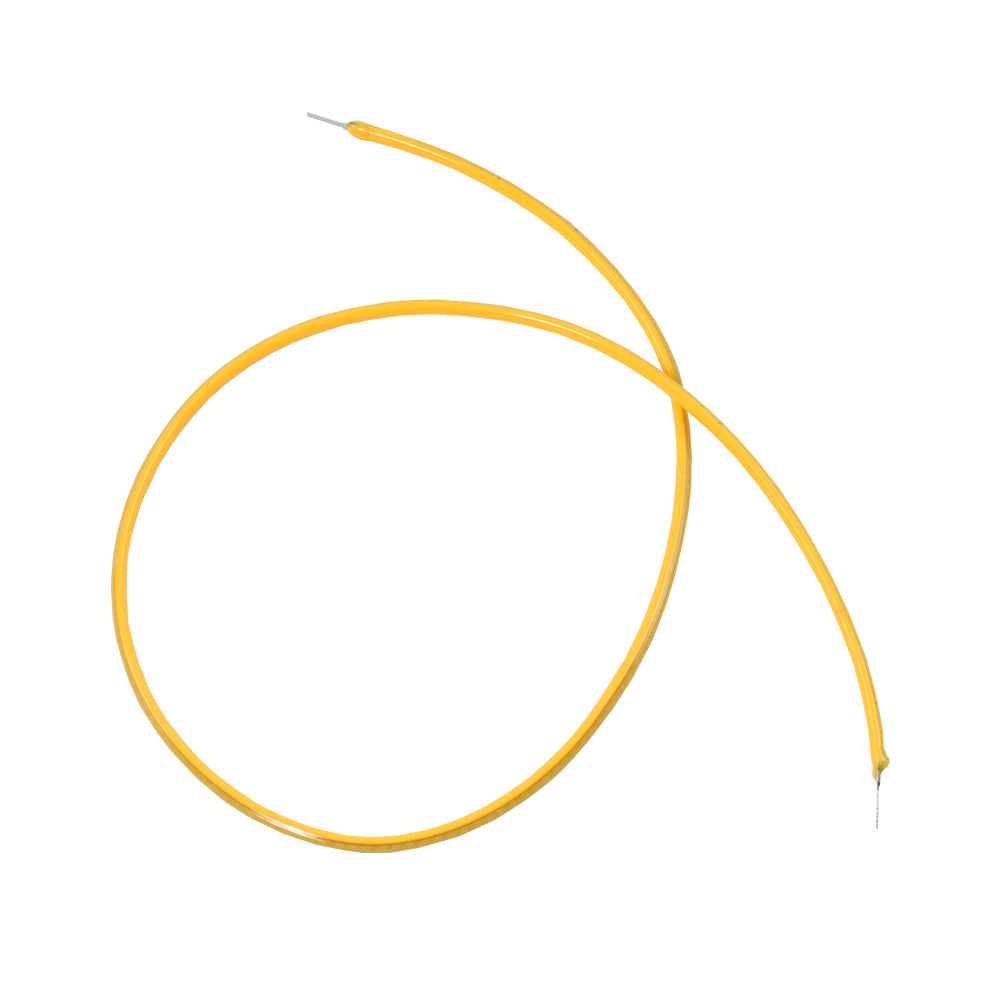

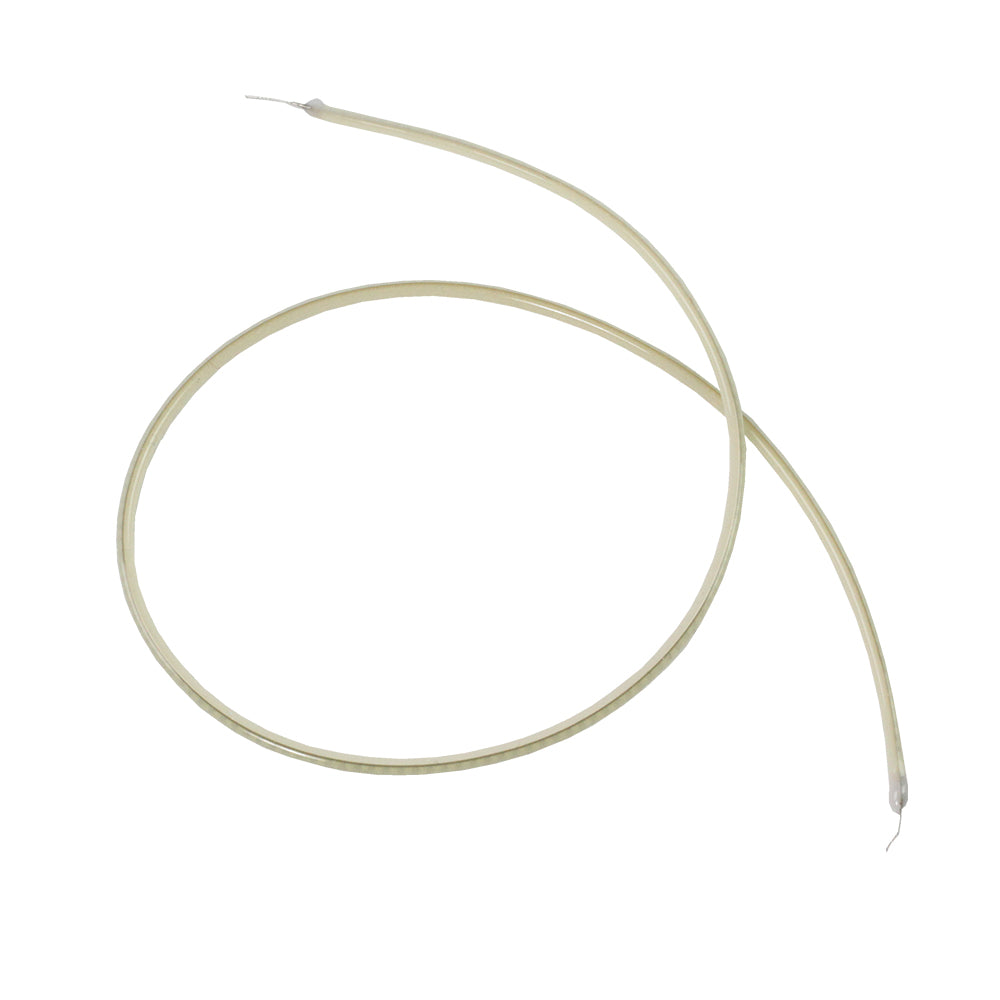
These bright and super flexible LED noodle filaments are 300mm in length (including the connections at either end) and can be bent, folded and loosely tied in knots at will. Each 300mm filament contains 200 microscopic LEDs hidden in the colourful silicone outer shell/diffuser. They are currently available in 5 colour varieties, they are; pink, white, warm white, green, and blue and they emit a full-angle 360-degree light.
Because these incredibly versatile lights can be moulded into all manner of shapes and their modest power requirements, they can be used in many different ways. They can be attached to shapes, bent around corners, put into semi-opaque tubes, used as pseudo neon signs, added to fancy dress costumes/props, used to decorate displays and much more! They can even be stitched into designs and tied in knots. Note: Care should be taken when bending as damage can be caused by overzealous handling.
The operating voltage for all of the colour varieties is 3V, on one end of the strip is the + connection (a flat metal tab with a hole in the middle), and on the far end is the – connection (a flat uninterrupted metal tab). Some of the options for powering the filaments are; coincell batteries or AA/AAA battery packs with 2 x 1.5 batteries. If using a power supply that provides more than 3V, a suitable resistor should be used to protect the filament from damage. For more detailed technical information, please refer to the Datasheet.

Note:
- These noodle filaments are not indestructible, care should be taken when shaping them. They bend readily but don’t react well to being twisted, pulled too tightly into a shape, or repeatedly flexed back and forth.
- The stated lengths of 300mm are for the total length, including the connections at either end.
- The colour descriptions are an approximation of the actual colours. E.g. white has a hint of yellow and is close to a natural white. The warm white has some orange in it and has a slightly flame-like hue.
Features:
- Bright, versatile, and flexible noodle filament lights, measuring 300mm long.
- They can be moulded into shapes, bent around corners, stitched into designs, or even knotted.
- The filaments emit a full-angle 360-degree light.
- They can be powered with coin-cell batteries or AA/AAA battery packs.
- If using a power supply that provides more than 3V, a suitable resistor should be used.
- Available in 5 colour varieties, they are; pink, white, warm white, green, and blue.
Contents:
- 1 x Flexible LED Noodle Filaments – 300mm, 3V.
Available in the following colour varieties:
- 35178 Pink Flexible LED Noodle Filaments.
- 35179 White Flexible LED Noodle Filaments.
- 35180 Warm White Flexible LED Noodle Filaments.
- 35181 Green Flexible LED Noodle Filaments.
- 35182 Blue Flexible LED Noodle Filaments.
Dimensions:
- Length: 300mm
Requires:
Power can be provided by any of the following methods;




Reviews
There are no reviews yet.