0
Your Cart
0
Your Cart


Product versions:


Product description:

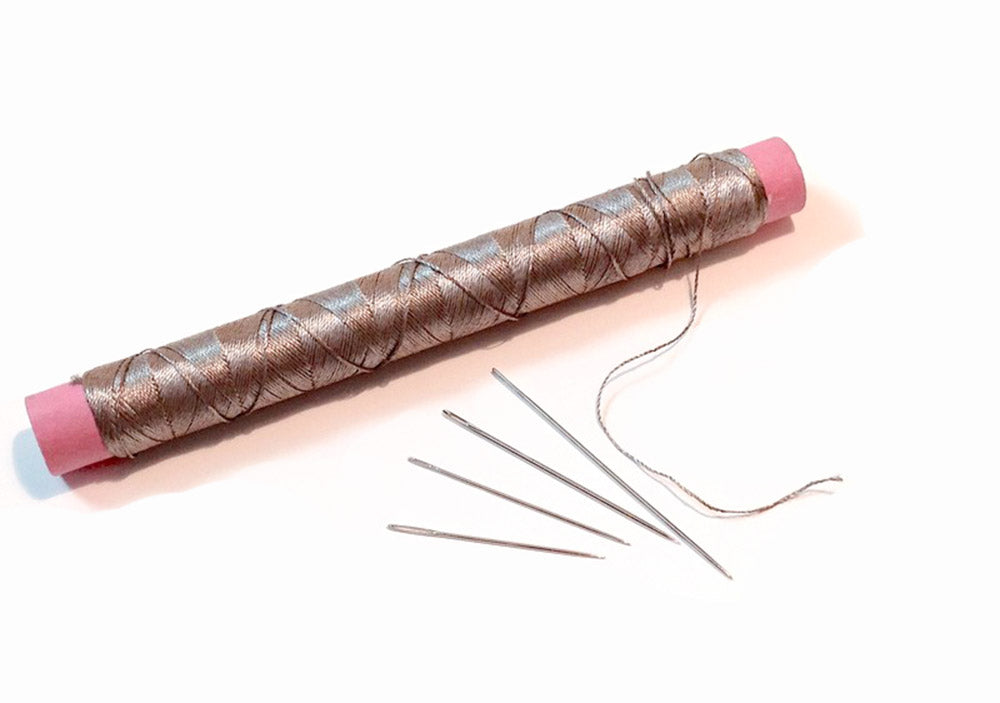
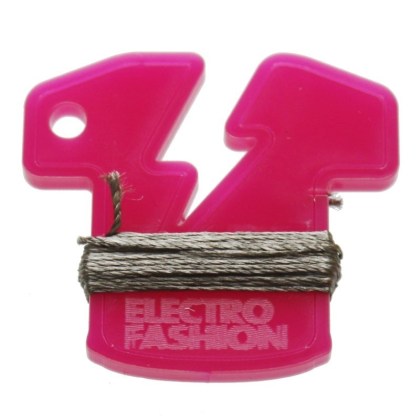
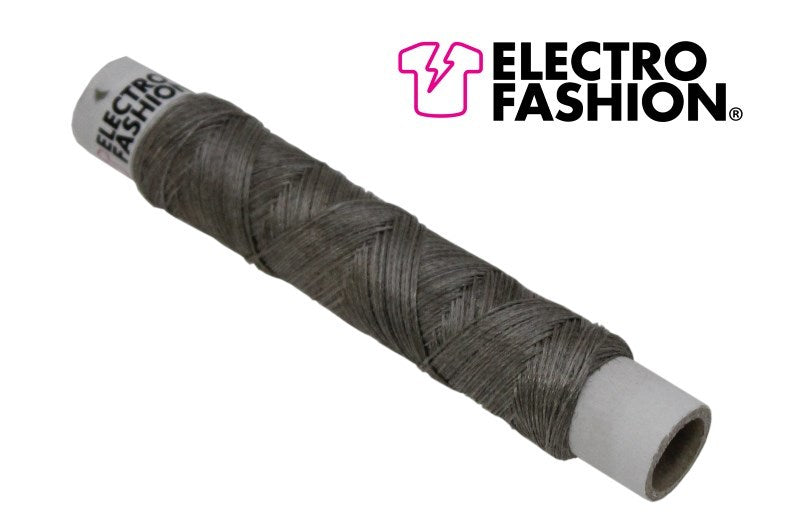
This is Kitronik’s very own Electro-Fashion® branded Conductive Thread and we think it is among the best conductive thread available. It is perfect for hand sewing and can also be used on the bottom bobbin of a sewing machine (this will require the thread to be wound on to the smaller bottom bobbin first).

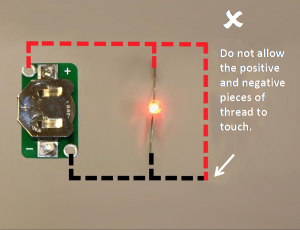
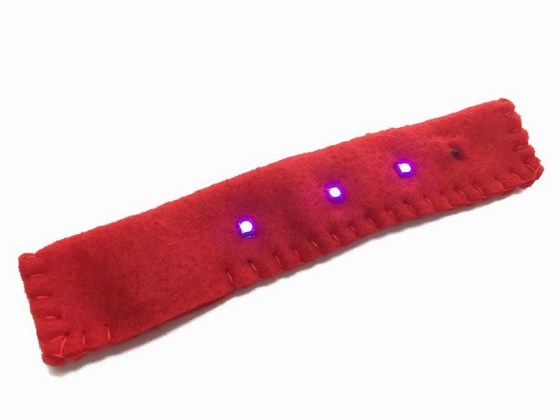
Conductive thread can be used like conventional sewing yarn, however it electrically conducts allowing electronics to be integrated into textiles. This makes it ideal for use in a range of e-textile applications.

The thread is nano plated with silver to make it conductive. The conductive thread has a generally low resistance but it does vary. We have measured between 40 and 160 ohms per meter, depending on the tension the thread is under. Once sewn the resistance is typically in the middle of this range. Over time the silver plating will degrade particularly if washed and we have measured in excess of 280 ohms on some of our older examples.

Resistance does not vary significantly from one length of thread to the next, so you should be able to use this thread without concern for “dead” sections.

The conductive thread has a breaking strain of around 9.3 pounds (4.2 kilos). It comprises roughly 96 individual filaments, each coated with a micron-thick layer of natural silver. This plating of the yarn is done in Europe to ensure as high a quality finish as possible. In construction, 16 of these filaments are wound together to form an initial twist; two of these twists are then twisted together, and finally, three of these twists are combined to form the finished thread. The conductive thread is approximately 18 denier. It is heavier than a regular sewing thread, but not as heavy as an upholstery thread. It can be sewn on most domestic sewing machines using either a regular needle or the next size up. This thread does not fray.


Features:

  • No (or very low) fray.
  • Resistivity = approximately 80Ω per metre (24.4Ω per foot).
  • Count = 875 dTex.
  • Strength 3000 cN.
  • Elongation at break = 37%.
  • Twist = 240Z-380S.


Contents:

  • 1 x Reel Electro-Fashion®, Conductive Thread, 50 yards / 45m.


Resources:

Documents & downloads

Related resources

Reviews

There are no reviews yet.

Be the first to review “Electro-Fashion conductive thread, 50 yards/ 45m”

Your email address will not be published. Required fields are marked *

Questions and answers

    HiHow much the yarn can stand UV light from the sun ?Simo
  1. 0 votes
    Q HiHow much the yarn can stand UV light from the sun ?Simo
    Asked by Simo on February 4, 2020 12:00 am
    Answered by the admin Hi Simo, Thank you for your email, I would say not a whole lot of resistance to UV unfortunately. Best Regards Cullen Lewis
  2. Hi,Can I electroform this thread? I want to use it in electroforming jewellery.Thanks.
  3. 0 votes
    Q Hi,Can I electroform this thread? I want to use it in electroforming jewellery.Thanks.
    Asked by Jane on April 9, 2019 12:00 am
    Answered by the admin Hi Jane, Thank you for your question, I have not tested it but I suspect electroforming would not work well. The thread is nylon that has been plated with silver then with another alloy plated over the top to protect it. From what I have looked at I do not think it would respond well to electro forming. Best Regards Cullen
  4. Hi,I was wondering if you can sell your thread in any higher quantities than 50 yards? Also, would you be willing to send me a sample so that I can test the durability and heat resistance of your product, and compare it to the thread I am already using.Thank you for your time, I hope to hear back from you soon.
  5. 0 votes
    Q Hi,I was wondering if you can sell your thread in any higher quantities than 50 yards? Also, woul...... Read more
    Asked by Scott Wheeler on August 2, 2018 12:00 am
    Answered by the admin Hi, we have a 250m length here.
  6. What is the maximum current carrying capacity for this thread?
  7. 0 votes
    Q What is the maximum current carrying capacity for this thread?
    Asked by Catriona Walker on May 9, 2017 12:00 am
    Answered by the admin Hi Catriona, after performing some tests we recommend a current of 250mA, with a maximum current of 500mA being passed through the thread. At 500mA the thread began to get warm, however this was only warm and not hot, as such this would still be a safe working current.
  8. Is this thread easily solderable?
  9. 0 votes
    Q Is this thread easily solderable?
    Asked by Dave Hunt on July 9, 2015 12:00 am
    Answered by the admin You can't solder the conductive thread, it would just burn if you tried to solder it.
  10. Hi, if I was to use this conductive thread and connect it to a small battery supply say about 900mAh or less...if I then touched the thread...would I get a small electric shock?
  11. 0 votes
    Q Hi, if I was to use this conductive thread and connect it to a small battery supply say about 900...... Read more
    Asked by andrew on October 1, 2014 12:00 am
    Answered by the admin Hi, that depends on the voltage of the battery, but realistically the thread would burn up before allowing high enough voltages to give a shock.
  12. Hello, what is the raw material of these yarns, it doesent look cotton to me, as mentioned above.
  13. 0 votes
    Q Hello, what is the raw material of these yarns, it doesent look cotton to me, as mentioned above.
    Asked by Simona Vasile on September 5, 2014 12:00 am
    Answered by the admin Hi, it is cotton. It's impregnated with silver though so it has a shiny grey appearance. It's still completely soft and feels like regular cotton.
  14. If i used this thread to weave a wall hanging behind my bed with normal thread would it shield from EMF's from the walls electrics? How much of the conductive thread would i need to use for it to be affective in comparison to the other normal thread? thank you!
  15. 0 votes
    Q If i used this thread to weave a wall hanging behind my bed with normal thread would it shield fr...... Read more
    Asked by Amy Ilic on June 19, 2014 12:00 am
    Answered by the admin It might work to some degree, aluminium foil would do the job better. Lower resistance and more homogeneous.
  16. Hi. I was wanting to stitch 10 to 50 colour changing LEDs in parallel over a 3 metre long fabric project. The power supply will be mains using a 5 volt power lead (I've read other information regarding matching volts of LEDs to the power supply and not needing a resistor). The power source is at one end of the line of LEDs and can't be positioned in the middle or anywhere else. My question is :- With the conductive thread loosing power over long distances. Would it improve the brightness of the LEDs furthest away from the power source, if I was to start using a double or triple strand of thread halfway through the 3 metre long project? Or does the mains 5 volt supply improve the brightness of the LEDs furthest away, compared to using a battery? Can you suggest anything else to improve the brightness. Thank you
  17. 0 votes
    Q Hi. I was wanting to stitch 10 to 50 colour changing LEDs in parallel over a 3 metre long fabric ...... Read more
    Asked by Zee on June 17, 2014 12:00 am
    Answered by the admin Hi, the brightness is limited by the current. Current is I = V/R so to increase the current you can increase the voltage or lower the resistance.

    Raising the voltage will put more power through the thread though and that will cause it to heat up and eventually burn out.

    The solution is, as you identified, to lower the resistance by adding more threads. Each time you double the distance to the battery you double the resistance, which can be counteracted by using twice as much thread. (2 threads instead of 1, or 4 threads instead of 2).

    Balancing them perfectly would be quite difficult though.
  18. Is this thread made from Nylon? Do you know the diameter of the individual filaments?
  19. 0 votes
    Q Is this thread made from Nylon? Do you know the diameter of the individual filaments?
    Asked by Sam on June 6, 2014 12:00 am
    Answered by the admin No the thread is a cotton-silver blend. I don't know the exact diameter of the filaments. The diameter of the thread is about 1mm and there are 96 filaments in it so that would give a filament diameter of approximately 0.01mm
  20. How does this thread stand up to corrosion over time? Other silver plated thread I have used does not stand up after about a year or so.
  21. 0 votes
    Q How does this thread stand up to corrosion over time? Other silver plated thread I have used does...... Read more
    Asked by Rachel McCrafty on May 28, 2014 12:00 am
    Answered by the admin Corrosion will depend on the environment the thread is in. I've never noticed any corrosion from the thread on our shelves. I don't have any data about the thread being repeatedly washed or exposed to the elements though.
  22. Can I use this thread to make touchscreen gloves out of non touchscreen gloves?!
  23. 0 votes
    Q Can I use this thread to make touchscreen gloves out of non touchscreen gloves?!
    Asked by Liz on April 22, 2014 12:00 am
    Answered by the admin Yes, just sew it into the fingertips to make little 'pads' of conductive thread. I've tested this myself :)
  24. Hello, Please could you tell me the resistant of the thread in ohms/per foot. Thanks Becca
  25. 0 votes
    Q Hello, Please could you tell me the resistant of the thread in ohms/per foot. Thanks Becca
    Asked by becca rose on September 12, 2013 12:00 am
    Answered by the admin The resistance of the thread is approximately 40ohms/metre or 12.2 ohms/foot
To submit a question, please login or create an account