
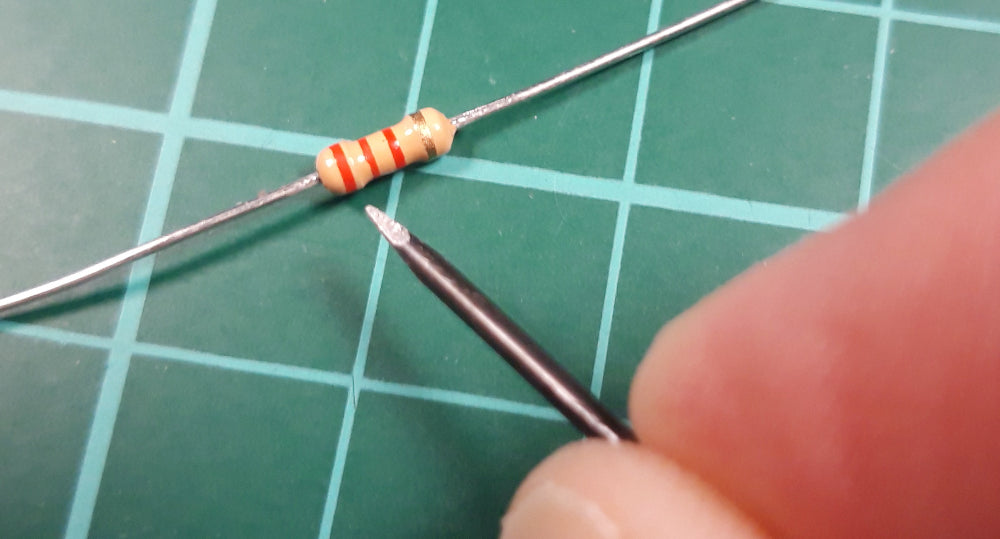
Resistors
A resistor is a device that opposes the flow of electrical current. The bigger the value of a resistor the more it opposes the current flow. The value of a resistor is given in ohms and is often referred to as its ‘resistance’.
Identifying Resistor Values

| Band Colour | 1st Band | 2nd Band | Multiplier x | Tolerance |
| Silver | ÷ 100 | 10% | ||
| Gold | ÷ 10 | 5% | ||
| Black | 0 | 0 | 1 | |
| Brown | 1 | 1 | 10 | 1% |
| Red | 2 | 2 | 100 | 2% |
| Orange | 3 | 3 | 1000 | |
| Yellow | 4 | 4 | 10,000 | |
| Green | 5 | 5 | 100,000 | |
| Blue | 6 | 6 | 1,000,000 | |
| Violet | 7 | 7 | ||
| Grey | 8 | 8 | ||
| White | 9 | 9 |
Example: Band 1 = Red, Band 2 = Violet, Band 3 = Orange, Band 4 = Gold
The value of this resistor would be:
2 (Red) 7 (Violet) x1,000 (Orange)
= 27 x 1,000
= 27,000 with a 5% tolerance (gold)
= 27k ohms
Too many zeros?
kilo ohms and mega ohms can be used:
1,000 ohms =1k
1,000k = 1M
Resistor Identification Task
Calculate the resistor values given by the bands shown below. The tolerance band has been ignored.
| 1st Band | 2nd Band | Multiplier x | Value |
| Brown | Black | Yellow | |
| Green | Blue | Brown | |
| Brown | Grey | Yellow | |
| Orange | White | Black |
Calculating Resistor Markings
Calculate what the colour bands would be for the following resistor values.
| Value | 1st Band | 2nd Band | Multiplier x |
| 180 ohms | |||
| 3,900 ohms | |||
| 47,000 ohms (47k) | |||
| 1,000,000 ohms(1M) |
What does Tolerance mean?
Resistors always have a tolerance but what does this mean? It refers to the accuracy to which it has been manufactured. For example if you were to measure the resistance of a gold tolerance resistor you can guarantee that the value measured will be within 5% of its stated value. Tolerances are important if the accuracy of a resistors value is critical to a designs performance.
Preferred Values
There are a number of different ranges of values for resistors. Two of the most popular are the E12 and E24. They take into account the manufacturing tolerance and are chosen such that there is a minimum overlap between the upper possible value of the first value in the series and the lowest possible value of the next. Hence there are fewer values in the 10% tolerance range.
| E-12 resistance tolerance (± 10%) | |||||||||||
| 10 | 12 | 15 | 18 | 22 | 27 | 33 | 39 | 47 | 56 | 68 | 82 |
| E-24 resistance tolerance (± 5%) | |||||||||||
| 10 | 11 | 12 | 13 | 15 | 16 | 18 | 20 | 22 | 24 | 27 | 30 |
| 33 | 36 | 39 | 43 | 47 | 51 | 56 | 62 | 68 | 75 | 82 | 91 |
Answers
Resistor Identification
| 1st Band | 2nd Band | Multiplier x | Value |
| Brown | Black | Yellow | 100,000 ohms |
| Green | Blue | Brown | 560 ohms |
| Brown | Grey | Yellow | 180,000 ohms |
| Orange | White | Black | 39 ohms |
Resistor Markings
| Value | 1st Band | 2nd Band | Multiplier x |
| 180 ohms | Brown | Grey | Brown |
| 3,900 ohms | Orange | White | Red |
| 47,000 ohms (47k) | Yellow | Violet | Orange |
| 1,000,000 ohms (1M) | Brown | Black | Green |
Download a pdf version of this page here  Learn more about the author read more » If you found this article helpful and you would like to receive product updates and free electronic resources from us then sign up here. We hate spam too and promise to never sell or share your email address, and you can unsubscribe at any time.